
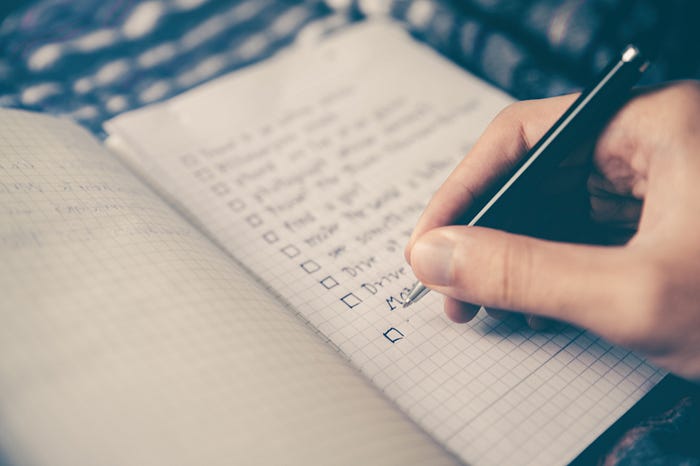
“80% of life is showing up”― Woody Allen
In this post, I’ll try to share some simple techniques to get organized, and talk a bit about why I bother with them.
Why all the fuss ?
Are you actively trying to reach your goals ? Whether it’s saving the rain forest or fixing the toilet, are you sure you’re on top of what matters to you ? If sometimes you feel like instead of you managing your tasks, they are managing you, read on!
If you have a lot of “things” you have to keep track of, either in your personal or professional life, chances are you could use some sort of organisation system to help you keep track of all of them, in a way that makes sense to you.
Of course you can live without any such system. Maybe you’re just super-clever and can keep everything at once inside your head (unlikely). Or maybe by forgetting stuff you wanted to do, you keep a manageable number of items in your head. But I think actively trying to stay on top of your stuff is the better choice.
To sum it up, for me, there are three main reasons why I bother:
- Keeping everything you want to do in your head is a huge source of stress. Some background part of your brain is constantly afraid of missing commitments. And when you actually miss them (maybe because you forgot), that just adds more stress. On top of that, your brain often reminds you about important things just when you can’t do anything about them. The result - you guessed it - is more stress.
- I like to have goals, both at work and in my personal life, and to work hard to achieve them. I know that I always bite off more than I can chew, so I need a way to prioritize and avoid dropping or delaying the important stuff.
- The urgent vs important problem. Your brain is pretty good at reminding you of urgent stuff. The problem is, like a former US president said — “I have two kinds of problems: the urgent and the important. The urgent are not important, and the important are never urgent”. I find that I need to explicitly manage and keep track of “important” stuff, otherwise I just keep doing “urgent stuff”. And that’s a sure way to fail on your major goals.
If you’ve read this far and agree that some sort of organization system is a good thing, how can you build one that works for you ?
How to build your system
You’ll need some sort of system you can trust, and doesn’t take too much time to organize and maintain. After all, you want to be moving forward with your goals, not wasting time managing your system.
In its simplest form, a personal organisation system is just a way to keep track of the important things in the various areas in your life. Ideally, it will allow you to organize, prioritize and plan, so you can be sure you’re doing what actually needs to be done, and leaving other stuff for later (or never). Besides focusing on stuff to do, it should also help you keep track of important information, and help with your workflows.
You’ll need a system that’s flexible, since priorities keep changing, and new stuff is always coming in. Avoid building your organization system around the concept of pre-planning all your time, things usually change too fast for that.
You have probably read about complex systems, software tools, processes, methodologies and gurus. While they do have their value, I don’t think there’s a silver bullet. You should probably learn a few of them, and just do what works for you. That being said, the system that I use and I’m describing in this post is mostly GTD.
To start, you’ll need a few tools and some simples processes.
The tools you’ll need
There are three main parts of your system that I think are the core of it:
- A task list — the things you want or need to do
- A calendar
- Some type or archiving and/or note taking system
The need for a task list is pretty obvious, since we all have a lot of stuff to do. But a simple list is usually too simple, keeping multiple lists is important. They should be separated by areas that matter to you. You don’t want to mix your home improvement ideas with things you have to do at the office. Another important point is taking the time to prioritize those lists, and make sure the stuff that’s on them is actually something you can do, not just a general ideal. But more on that later.
You’ll need a calendar to keep track of events that have a specific date and time. Avoid using your calendar to schedule other types of events, those you should keep in your task list. An important exception to this is that sometimes it’s useful to just block out a specific piece of time on your calendar to work on some complex or time consuming problem.
Note taking and archiving are also an important part of any personal organisation system. Without logs of what happened before, and other archived information or references, we lose a lot of context that may be important to what we’re trying to achieve. And without analyzing the historical context of a goal or project, and just looking at it’s current status and outstanding tasks, we risk getting stuck in circles, always trying to do the same and failing. So keep logs about relevant stuff that happens to find patterns and know the past of a given issue, it will help you plan its future. Keeping notes separated by project or area is also a good idea, to keep your notes from becoming a huge blob. But the main thing about your notes and archive is that it’s a different thing from your tasks list, so it’s important not to mix them.
These three items form the basis of a simple organization system, but there’s a 4th part that’s equally important. That’s how new stuff enters your system and how the stuff that’s already in gets handled.
Handling your stuff
So now let’s put the system to work. To start, you have to actually build it. You can do it all at once, or incrementally.
If you’re doing it incrementally, just apply your system to your stuff as new things come along, or as you remember existing things. So if you think about something important, just put it in your inbox (more on that right ahead) to sort out later.
If you choose to do it all at once, you’ll need a lot of time to go through all your tasks, add them to your task lists (in their respective projects/areas), analyze them, prioritize them, and generally get your system to a point where you feel your important things are there.
While in theory doing it all at once is better, the truth is that incrementally moving to a good system is better that having a grand objective of doing everything at once and never actually doing it. So it really depends on your specific circumstances. But even if you choose to do it incrementally, a small initial setup will help.
How to deal with new things
An important part of your process is how to deal with new stuff. A good way is just adding it to your inbox, to sort out later. Your inbox is just another task list. In reality, you may have many inboxes (such as your email, etc..), but we’ll leave that for another day.
With that standard way to deal with new stuff, you won’t forget it, but you also won’t need to constantly interrupt what you are doing.
Once you have an inbox, then you’ll have to clean it regularly. Some people will need to do it several times a day, others less frequently, it depends on your specific case. When cleaning your inbox, take a systematic approach to stuff there:
- Is it something small, but worth doing, that can be done in a couple of minutes ? If so, just do it
- Are you even the best person to do this ? If not, just ask whoever you think should do it
- Is it something complex or time consuming ? Add it to whatever task list makes sense, and forget about it for now
Sometimes stuff that comes your way isn’t actually something to do. It’s just something to know. In that case, just take a note about it or archive it.
Actually doing stuff
This is where you’ll spend most of your time, and it’s the actual reason you bother with all of this.
When you’re in doing mode, just concentrate on checking off items from your lists. Assuming you organized properly earlier, your tasks should be already prioritized and actually doable. Work down your task lists!
Reviewing
Sometimes you have to step out of doing mode, and enter organization mode. Instead of focusing on ticking off items in your task lists, go through them and think about the stuff there. Are those things still important to you ? Is the priority still the right one ? Do you remember something else that should be done about this specific project or area ? If what you’re reviewing is complex, it may be useful to read some of your notes about it to get some context and help you decide on the next steps.
How often you do this depends on how quickly things change in your projects, but a weekly review is a good place to start.
Tools
I’ve always believed in learning concepts before thinking about tools, so I’ve left them for last. If you’ve got only a few projects and tasks, almost everything will work as a support for your system, even a piece of paper. But realistically, most of us end up with hundreds of tasks, and so something a little more sophisticated is needed.
To keep and manage my projects and task lists, I use Omnifocus. If you’re on a Mac, it’s hard not to love it. If you’re on Windows or Linux, I’ve heard good things about Todoist. Both these tools keep simple things simple, and allow you to make them as complex as you need.
For keeping logs and note taking, both OneNote and Evernote work fine, and they’re available for both Mac and Windows. If you’re on Linux, you may need to use the web version, or find a similar application.
About that calendar, there are so many around, and you probably already use one, so I guess recommending one is pointless.
Further reading and references
I believe getting organised and taking control is a bit like a complex game. You can learn it in a few minutes, but it’ll take a lifetime to master. Besides, you will change over time, so what used to work for you will need to be tweaked to keep working.
There are lots of good books, posts and videos about organisation systems, these are some of my favourites. They mostly focus on GTD, since it’s the system I like best:
- “Getting Things Done” and “Making it all work” (by David Allen)
- http://tedx.amsterdam/talks/david-allen-getting-control-creating-space-natural-planning-model/
- https://inside.omnifocus.com/gtd
Some final thoughts
There’s a lot more to be said about getting organized, such as how to integrate with team organization systems, how to do your own capacity planning, keeping metrics, managing priorities across projects, dealing with various levels of detail, and so many others. We’ll leave those to another day.
But most of all, trying to get organized is a journey within yourself, and that’s what makes it interesting :)
If you have any comments or feedback on this subject, I’d love to hear from you!
About 10 years ago, I co-founded Runtime Revolution. We build great web and mobile products for our clients all around the world.
Runtime RevolutionWe are Rails, mobile and product development experts. We can build your product or work with you on your project.runtime-revolution.com