
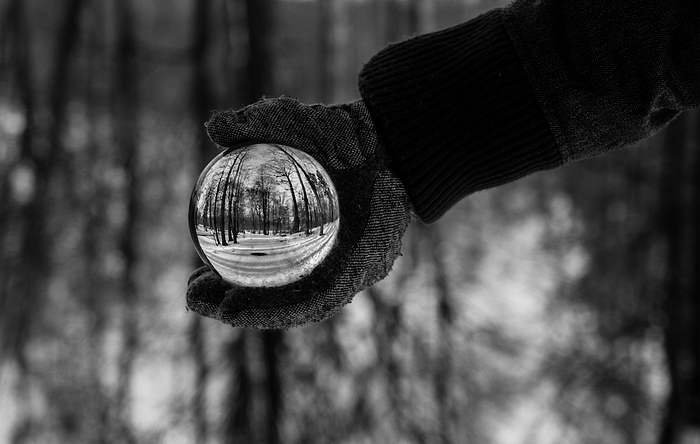
As a Designer for the constantly evolving digital media, if I had a crystal ball to predict the future based on the present trends, what will I be doing in a couple of years? This is a “million-dollar” question I always try to find an answer for along my professional years. Technology is always changing and, let’s face it, we can’t predict very accurately what’s going to happen next.
If you thought Google Glass was “the thing”, you may not be entirely wrong! — Did you hear that it’s coming up again? But different: now it’s more focused on businesses. And who ever knew the iPhone could change so much the industry 10 years ago? Things like these change people’s lives and give them whole new experiences. The jobs they do will be done differently because of the technology. And so is mine.
Design to web-based technology has to have in account all these new interactions given by those devices. The interaction paradigm is no longer “point and click” or even touchscreen… The voice and image recognition in real-time is arising at a fast pace. We also have all those wearable sensors in our bodies that communicate constantly to the devices. And don’t get me started on geo-location…
However, there are some aspects I think can change the way things work in a close future… and can even rewrite some design patterns. Regarding what’s happening now in terms of tech evolution, here are my insights to some of the questions which the real answers can change the way designers in the digital means work.
1. Will the conversational interfaces be the new UI?
In my opinion, not entirely, but I believe components like forms are suffering a huge transformation. What’s the point on having to fill tons of fields with a lot of components to click on when we can connect with social networks to provide most of the information or have a conversation with a bot that understands natural language? We will still be having visual elements (like dashboards) in our lives. They give a lot of information in a row. When things get visual sometimes we understand them faster. If you’re an interface designer, don’t worry, you are far for being doomed!
2. Will the robots with natural language and expressions replace the interfaces?
Humans like to communicate with other humans… and by communicate I don’t just mean language. Gestures and expressions also take a big role on that communication. What happens when technology gets “humanized”? We start to create a connection with it (but it’s kind of creepy if they start to look like actual humans, or maybe it’s a natural thing in the future, who knows?). Imagine having a personal assistant that you can ask anything and they just tell you. Why bothering having a visual interface for that? Ok, we will still need that in some cases. I don’t imagine using a GPS without the visual interface to guide me. Some people can, but I’m not one of those people. I also like to use SIRI a lot… It’s not a robot, but it works with natural language. The only problem is that I don’t like to talk to it when I’m in a public crowded space. I like to keep some conversations private. Now imagine SIRI with a human form, gestures and expressions capable of performing the same tasks humans do. Do we still need the guy serving in a seafront? Is the cooker really needed? And what happens when self-driving cars take over? A lot of jobs will have to be reinvented in the years to come. We will still be using interfaces. Interfaces evolve… even a robot can be itself an interface. I’m still comfortable with this scenario… Designers will still be needed!
3. And what about AI… what will it do to the user experience?
Learning Machines and Artificial Intelligence are making us interact less and less with devices. By learning our behaviors they can provide better experiences.
The Grid, for instance, is a “build-by-itself” website platform based on a Artificial Intelligence that even performs A/B testing to see what the best layout would be for each scenario. It’s a great start, but it still needs designers’ input to figure out how to combine all those elements in its algorithm. Machines don’t really have sense of aesthetics… They can, however, learn behaviors and understand user’s preferences. They know what they prefer, but not why they do. Of course, after a certain time they start to understand patterns that can help them figuring out the “why”, but still isn’t a sure thing… a white in a composition can be “why” the users prefer a certain picture among other, but sometimes the white works because of other elements like the layout. Machines need to learn a lot to get to that point and I’m still sceptic regarding if they ever will.
As a user experience designer, I’m not worried about a machine replacing my job. I am, in fact, looking forward to use that knowledge to deliver a better user experience.
4. Where is this going, what will have to be adapted in the industry?
I think we have to wait and see. I’d like to have that answer to be able to anticipate the next move. What is possible to do is to keep up and try to get the most of the tools and technology we currently have to provide the best experiences to our users. Don’t forget that the technology we have in our hands nowadays is powerful.
I would like to see what happens 10 years from now, maybe I will look at this text and think “You had no idea how much has changed!”.
Do you have any comments or feedback on this subject? We’d love to hear from you!
At Runtime Revolution we care about the user experience. We are a team of designers and developers willing to make your ideas a success.
Runtime RevolutionWe are Rails, mobile and product development experts. We can build your product or work with you on your project.runtime-revolution.com